How TextNow learned when YouTube awareness starts driving lower-funnel lift
- 26 weeks
- of YouTube treatment
- 1.84%
- total W2PU lift after the post-treatment window
- 87%
- of the measured effect accumulated after the first two months

- Industry
- Mobile Apps
- Channels
- YouTube
- Features used
- GeoLift
The challenge
Measure brand with rigor, but not on a performance-media clock
TextNow makes it possible for people to stay connected through free and flexible phone service. Its growth team had built a mature incrementality program to understand which media investments were generating outcomes that would not have happened otherwise.
The team’s next question was harder. TextNow was preparing to invest further up the funnel and wanted to know whether YouTube campaigns optimized for reach and video completion could eventually influence lower-funnel behavior.
Platform studies could show whether the campaign affected brand metrics. They could not show how many users became active because of the campaign. TextNow wanted to measure that impact against Total Week 2 Primary Users, or Total W2PU, a business KPI that captures users who remain active into their second week.
But awareness media might not produce an immediate lower-funnel response, making a short test easy to misread. TextNow did not just need to know whether YouTube worked. It needed to understand when YouTube’s impact would become visible in the outcome the business cared about.
The solution
TextNow partnered with Haus to run a 26-week geo experiment from December 2025 through May 2026, followed by a six-week post-treatment window.
The team geo-fenced 20% of the United States, drawn as an 80/20 design so the smaller partition behaved like a scaled-down version of the country rather than a convenient set of markets. Half of those markets received YouTube reach and video-completion media, while the other half formed a holdout for estimating incremental Total W2PUs. Business-as-usual media was designed to stay balanced across both groups, and TextNow could keep running other experiments across the rest of the country.
The design let TextNow track whether lower-funnel lift emerged, when it became visible, and how the measured result changed after media stopped.
Readout schedule
The result
The first month missed the story
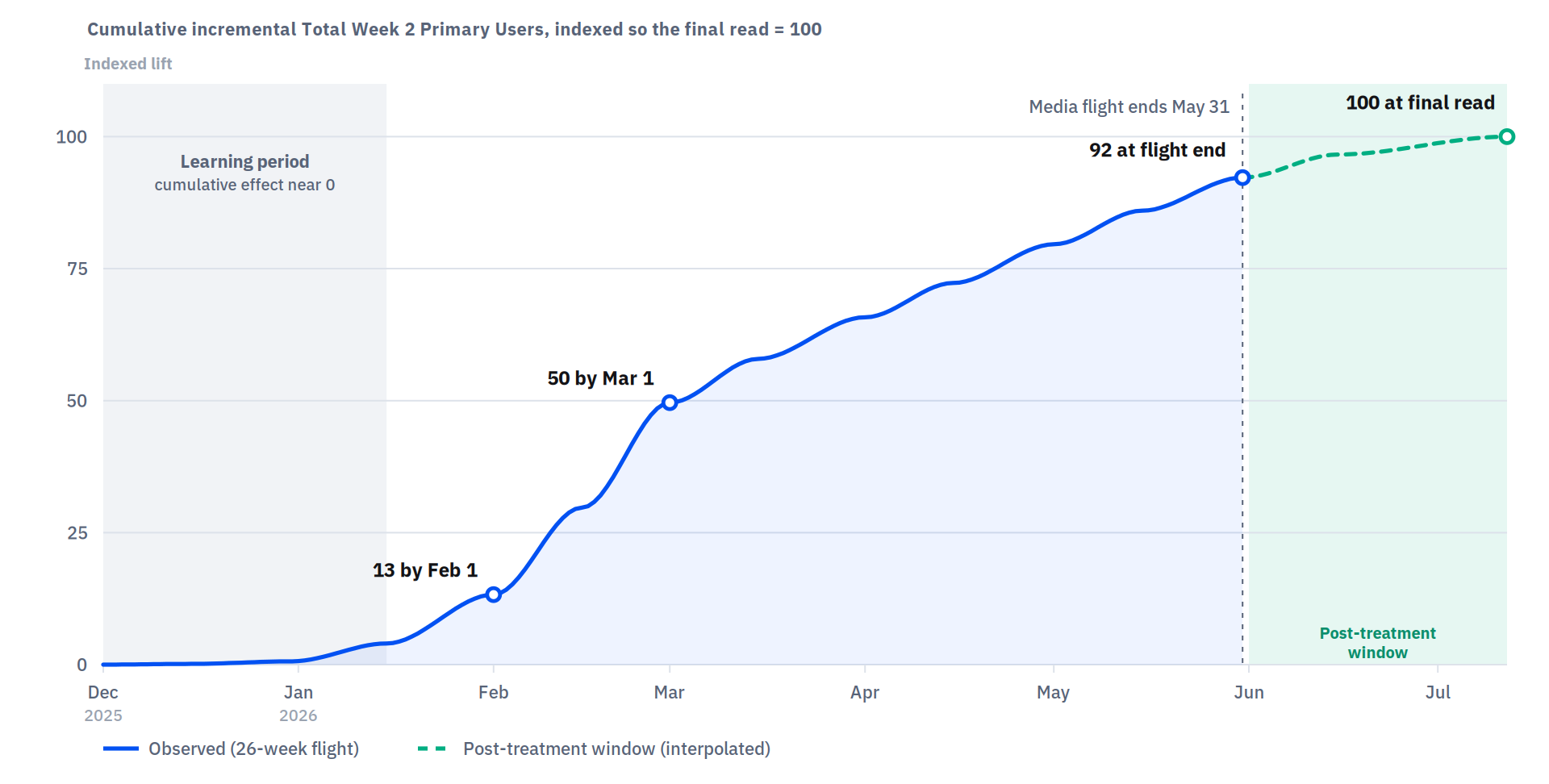
For roughly the first five weeks, cumulative lift hovered around zero.
Had TextNow ended the experiment after four to six weeks, the early read could have understated or missed the lower-funnel effect that emerged later. Instead, TextNow kept the experiment running.
The pattern began to change in late January. Two months into the test, cumulative incremental Total W2PUs stood at roughly 13% of their eventual level, which means about 87% of the measured effect accumulated after the first two months. By early March the cumulative result had reached about half its final level, with the clearest gains emerging through February.
The path was not perfectly linear. But the cumulative view told a clear practical story: The first month did not capture the effect visible in the complete read.
Efficiency became meaningful only after lift had time to build
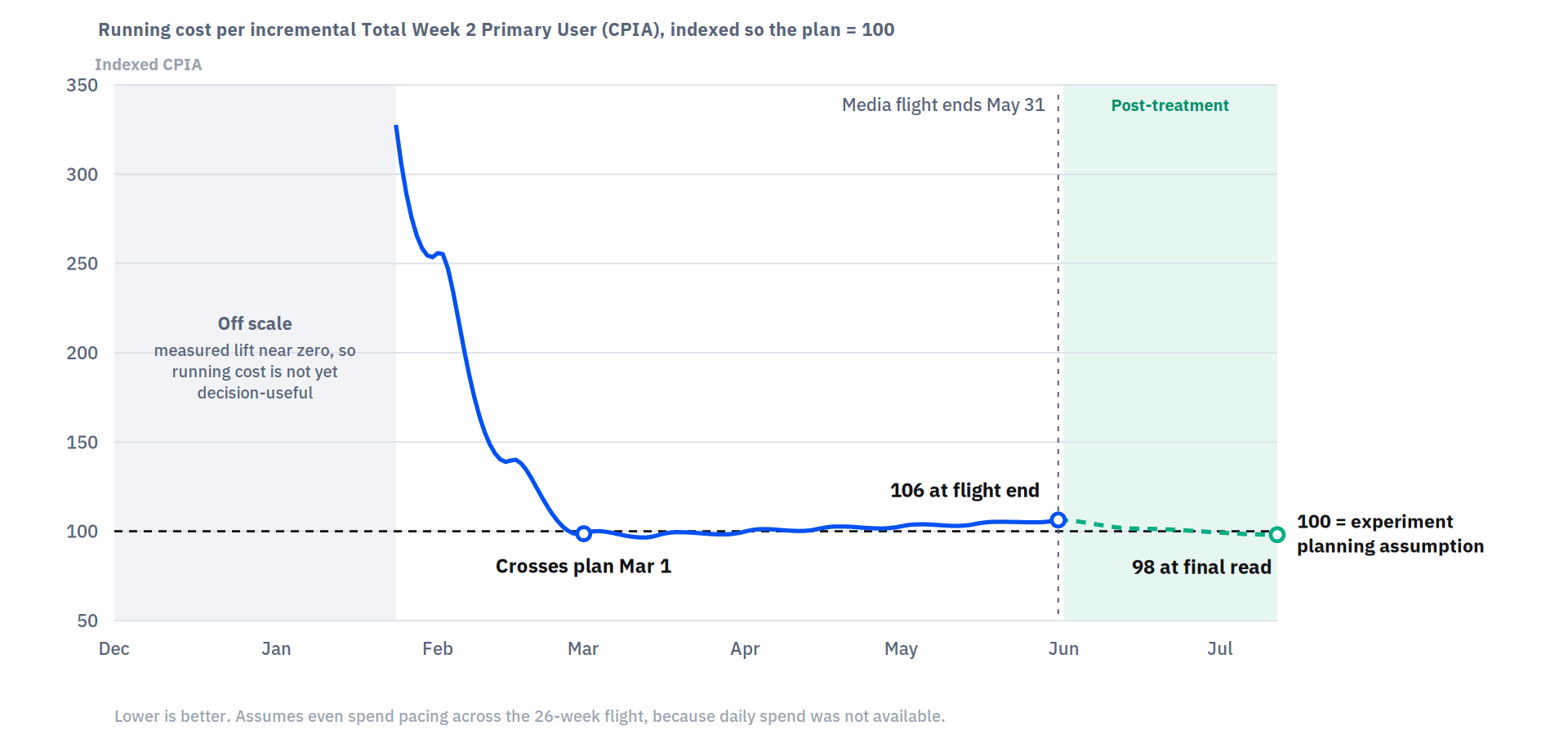
At the end of the 26-week treatment period, the experiment measured a 1.99% lift in Total W2PU at an indexed cost per incremental user (CPIA) of 106, or roughly 6% above the experiment’s planning assumption.
Including the six-week post-treatment window raised the point estimate and lowered measured cost per incremental user by roughly 8%, bringing the result just inside the planning assumption:
- 1.84% Total W2PU lift
- 98 indexed CPIA, against a planning assumption of 100, so roughly 2% inside plan
- ~8% improvement in measured efficiency versus the treatment-only read
One test gave TextNow a way to compare awareness and direct response
Until this test, TextNow had limited evidence for judging awareness media on lower-funnel outcomes. YouTube changed that.
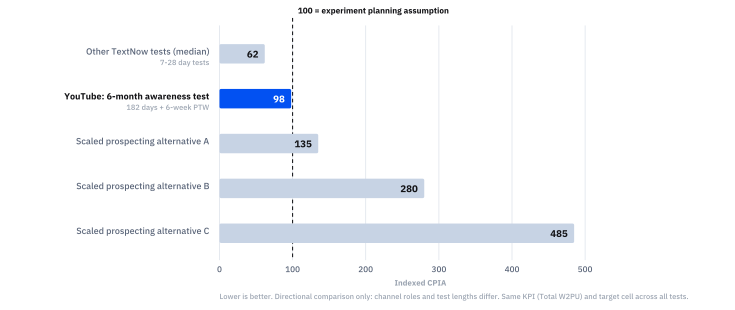
It finished at an index of 98, slightly better than plan. It did not beat TextNow’s median test at 62, but it came in below several scaled prospecting programs despite being optimized for reach and video completion.
The lesson was bigger than YouTube: Awareness does not have to be a blank check. TextNow could now evaluate upper-funnel channels against business outcomes and hold them to an efficiency standard.
Next steps
A long test can answer a different question
The experiment did more than give TextNow a YouTube scorecard. It gave the company a timeline for interpreting future awareness campaigns.
When internal teams later saw installs increase during the first week of a larger brand launch, the growth team could point back to the experiment. TextNow launched YouTube in December, but the clearest Total W2PU gains emerged months later. An immediate lower-funnel impact was possible, but it was not the pattern this test had established.
For TextNow, extending the test changed what the team could learn: not only whether lift appeared, but when the result became interpretable and how the measured outcome changed after treatment ended.
TextNow entered the experiment asking whether YouTube could influence a lower-funnel business outcome. The complete read gave the organization a company-specific benchmark for when that impact became visible.
Published: August 24, 2026