The TikTok Report

Can TikTok scale? How much omnichannel impact does TikTok have? Haus’ analyses of hundreds of TikTok incrementality tests answers these questions and more.

Patrick Hillery, Tyler Horner, and Emily Schwartz

Dec 4, 2025

Executive summary

TikTok is Haus’ third-most tested advertising platform.
There’s more variation in week-over-week spend on TikTok than on similarly scaled search and social channels, suggesting brands see opportunity in TikTok and are actively trying to find the sweet spot.

TikTok is a strong funnel-builder ahead of promotional periods.
Brands observed an additional 68% lift to their primary KPI during an experiment’s post-treatment window, during which delayed effects from advertising are measured. These effects were amplified even further when they led into promotional or seasonal windows.

TikTok is an effective driver of halo effects on Amazon and retail.
Data shows TikTok delivers nearly twice as much value – 1.9x – when brands look at omnichannel impact rather than measuring DTC lift alone.

Scale doesn’t come easy...
Many brands are able to find a sweet spot between 11-15% of their search and social budget on TikTok, but there remains a large gap in the scale brands typically achieve in TikTok against the top two ad platforms.

… but brands that have scaled TikTok effectively share similar characteristics.
They tend to target Gen Z and younger Millennials, sell lower-consideration offerings, have value propositions that are easily distilled into short clips, and deliver quick time-to-value for consumers.

Background

If you’ve been around the Haus block for a minute, you’ve probably noticed we like asking questions around here. In the past, we’ve dug into incrementality experiment data from platforms like YouTube, Branded Search, and Meta. This time, we wanted to learn more about TikTok.

In the world of growth marketing, there are a handful of TikTok-related questions we hear every so often. For example: 

  • Do I need TikTok to succeed?
  • Can TikTok scale?
  • Is TikTok “demand capture” or “demand creation?”
  • How much omnichannel impact does TikTok drive?
  • Is TikTok a strong investment during promotional periods?
  • Is TikTok a strong new customer acquisition channel? 

And so: We decided to do something about it. Let’s dive into these areas (and then some) to see what we can learn from the brands who have effectively woven TikTok into their media mix. From common characteristics they share to patterns we see in experiment data and business outcomes, let’s get into it.

About the data

  • We analyzed hundreds of Haus experiments across 2.5 years of data
  • The average experiment length was 21 days
  • The average post-treatment window (PTW) length was 9 days
  • The average advertiser in this study spends nearly $3 million annually on TikTok. 
  • Advertisers span an array of brands across Media, Apps, Gaming, Ecommerce, Health & Wellness, and Retail verticals

Finding the TikTok spend sweet spot

TikTok has been available in the United States since August 2018 – making it active for about 7 years at the time of this writing. To say nothing of it falling into geopolitical crosshairs, it has grown considerably as an advertising channel in a relatively short period of time. By the end of 2025, TikTok’s global ad revenue is projected to reach ~$33 billion.

When brands started running experiments on Haus in 2021, TikTok was a marketing wild card. Today, it’s our third-most tested channel after Google and Meta.

Not every brand tests TikTok frequently. But across brands who have run 3+ Haus incrementality experiments on TikTok, they have on average scaled TikTok by an additional 13% beyond their first-test baseline spend, relative to other digital channels in search and social.

How does that shake out? This subset of brands started with an average 11% of their search and social spend going towards TikTok. By the second test, often buoyed by strong incremental efficiency, they scaled to an average of 15%. However, this seems to be where they surpassed the point of efficient marginal returns, as this subset of brands settled on 13% of average search and social budget share on TikTok across subsequent tests.

You might read this and wonder, “Aren’t 11%, 13%, and 15% in the same general ballpark? How much does this difference actually matter?” The magnitude of this change could be quite significant – after all, the relative difference between 11% and 15% represents a ~36% increase in spend at the channel level. When brands are spending tens of millions of dollars across their portfolio, these seemingly small differences in optimal spend share represent significant swings in how much money is being efficiently vs. inefficiently invested.

It’s also worth emphasizing that these are averages; on average, brands slightly scaled up TikTok spend after testing, but some scaled down while others scaled up significantly. There’s only one way to determine which of those groups you belong in – and that’s with a well-constructed incrementality test (or multiple).

Across brands who have run 3+ Haus incrementality experiments on TikTok, they have on average scaled TikTok by an additional 13% beyond their first-test baseline spend, relative to other digital channels in search and social.

Brands advertising on TikTok see performance strengthen over time and ahead of promotional periods

One of the clear takeaways that emerged from the TikTok tests we analyzed was the impact that post-treatment windows and promotional periods have on incremental outcomes. 

Think about post-treatment windows as a period of time to gauge lagged or delayed effects. Across Haus TikTok incrementality experiments, brands observed an additional 68% lift to their primary KPI in the post-treatment window

With TikTok, there is a slight observed impact through the first half of the experiment, but lift blooms by 247% on average in the second half and post-treatment window as demand created in the first half is realized. This effect closely resembles similar behaviors we’ve seen on channels like YouTube, which suggests brands may want to think about TikTok as something closer to a top-of-funnel channel, rather than, say, Meta, where effects are near-immediate and capture existing demand in the market. 

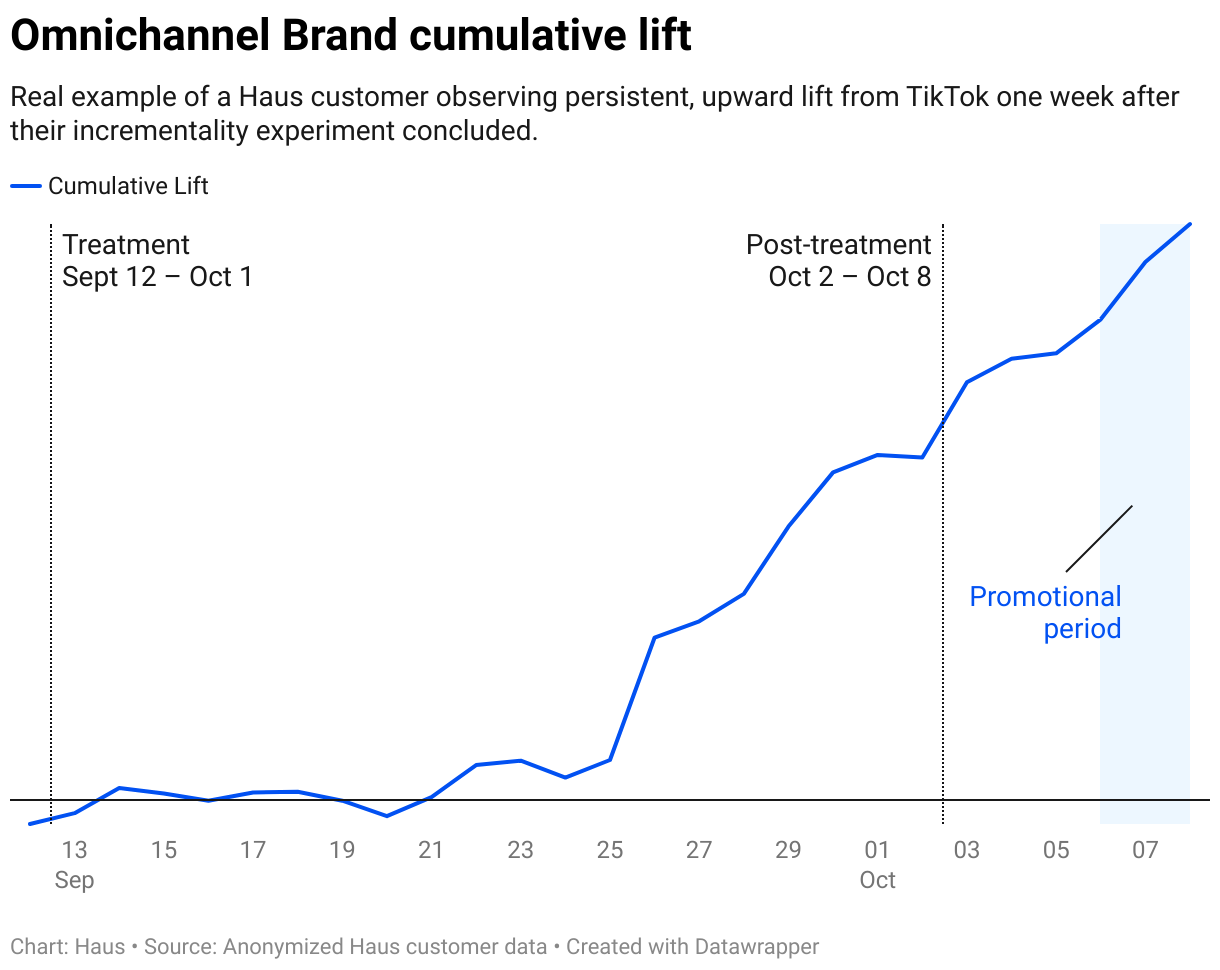
Let’s examine two representative experiments that illustrate this. In the graph below, we see anonymized data from Omnichannel Brand. The cumulative lift graph totals the observed lift each day to show the differences between treatment and control, and how consistent that difference is day over day. For the first half of the experiment, impact was negligible. As we continue into the second half of the experiment, we start to see real impact emerge. And as we cross into the post-treatment window, we see continued upward impact that extends into their promotional period.
In this second example below, we see anonymized data from a Long Consideration Cycle Brand, a DTC company that sells $400+ products on its website and Amazon. Long Consideration Cycle Brand ran a month-long experiment with Haus to measure the incremental impact of TikTok, but without a post-treatment window.
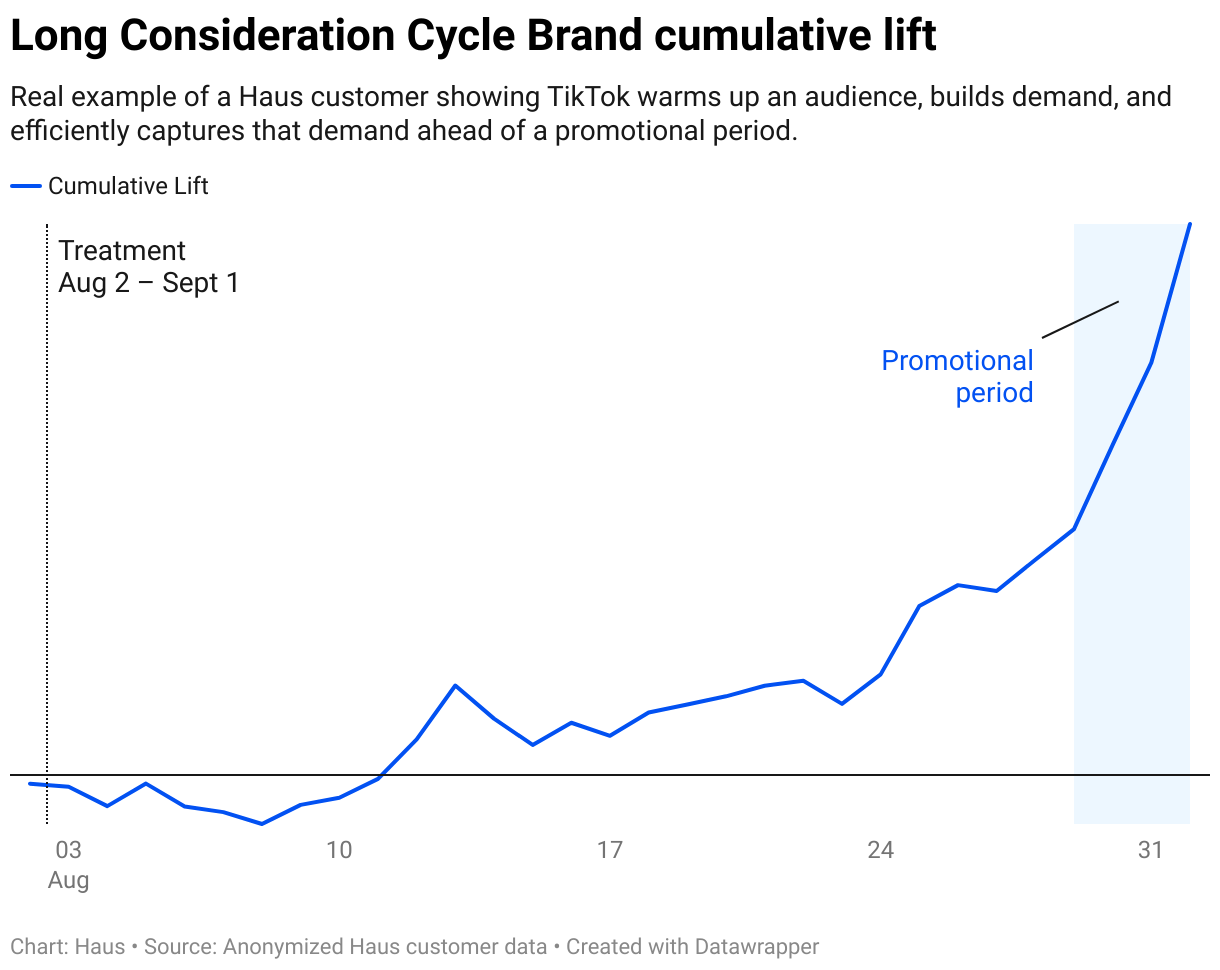
Similar to our first example, we see only modest impact in the first half of the experiment, with little difference between the treatment and control groups. In the second half of the experiment, we started to see a small upward impact emerge, but it wasn't until the last three days – a promotional period – where almost all of the impact from the media was measured. 

Both of these experiments represent a pattern where TikTok warms up an audience, builds demand, and efficiently captures that demand ahead of a promotional period. In both cases, these experiments seemed doomed for failure halfway through – but patience and the introduction of a promotional period painted a different story in business outcomes.

Brands seem to be wise to TikTok’s apparent asymmetric seasonal performance: Haus customers advertising on the platform have on average turned off spend for 14% of weeks so far this year. Further, the average delta between BAU spend and peak spend on the channel is 5.0x – speaking to brands’ instincts to pull back after a high period and lean away from an “always on” evergreen strategy.

TikTok fuels strong omnichannel halo effects and balance across acquisition and retention

Many brands suspect strong halo effects across their media mix (that is, identifying the impact that marketing spend in one place has on sales in another), but quantifying this isn’t always easy. In our analysis, we confirmed TikTok has a demonstrable impact on omnichannel sales for DTC brands. Additionally, TikTok seems to be a relatively balanced channel in terms of driving new vs. existing consumer activity. 

TikTok drives halo effects on Amazon and in retail 

What impact does advertising on TikTok have across other sales channels like Amazon and retail? For brands hoping the answer is positive, you’re in luck: Our experiment analysis shows that TikTok delivers nearly twice as much value – 1.9x – when brands look at omnichannel impact rather than measuring DTC lift alone.

For brands selling across DTC, Amazon, and retail, TikTok on average drove an additional 34% of sales to Amazon and 57% of sales to physical retail. That means for every dollar captured in ecommerce, an additional $0.34 of incremental sales was generated on Amazon, and $0.57 of incremental sales for brands selling in retailers such as Target, Sephora, Best Buy, Ulta, Nordstrom, and others.

By organizing and analyzing retail and Amazon KPIs, TikTok advertisers gain a comprehensive understanding of the omnichannel incrementality picture, enabling them to scale TikTok spend with greater confidence and quantify additional impact.

TikTok powers incremental sales for both new and returning customers

Finding new audiences for a scaling brand is no easy feat. Across experiments analyzed for DTC brands, we found that 62% of TikTok- lift drives new customer sales, making it a reasonably balanced channel with a slight lean towards new customer acquisition.

Characteristics of brands that successfully scale TikTok

It’s one thing to find that sweet spot where paid media on TikTok starts driving incremental outcomes – but it’s another to step back and consider how (or if) TikTok strategically fits into your media mix and business goals. For some brands Haus works with, TikTok has eclipsed even Google and Meta in ad spend share of wallet. Other brands have embraced TikTok as a smaller piece of their media mix puzzle, but successfully cracked the code on what makes it an incrementally effective business-driver. 

In our analysis (and anecdotal experience), brands testing on TikTok that have been able to successfully, incrementally scale typically share these characteristics:

  1. Demographics: They target Gen Z and younger Millennials
    Brands targeting Gen Z spend 2.7x more budget than brands targeting other generations.
  2. Price point: They offer lower-consideration products and services
    Advertisers with an average order value (AOV) of less than $50 spend 2.8x more budget than advertisers with AOVs greater than $50.
  3. Core offering + creative: Their value proposition is easily demonstrated in short clips
    Businesses who can show brand value in short clips spend 1.5x more budget than businesses that fail to convey their value concisely.
  4. Time to value: Their business model allows for low-friction onboarding or trials
    Services offering free trials spend 1.8x more budget than services requiring users to pay upfront. 

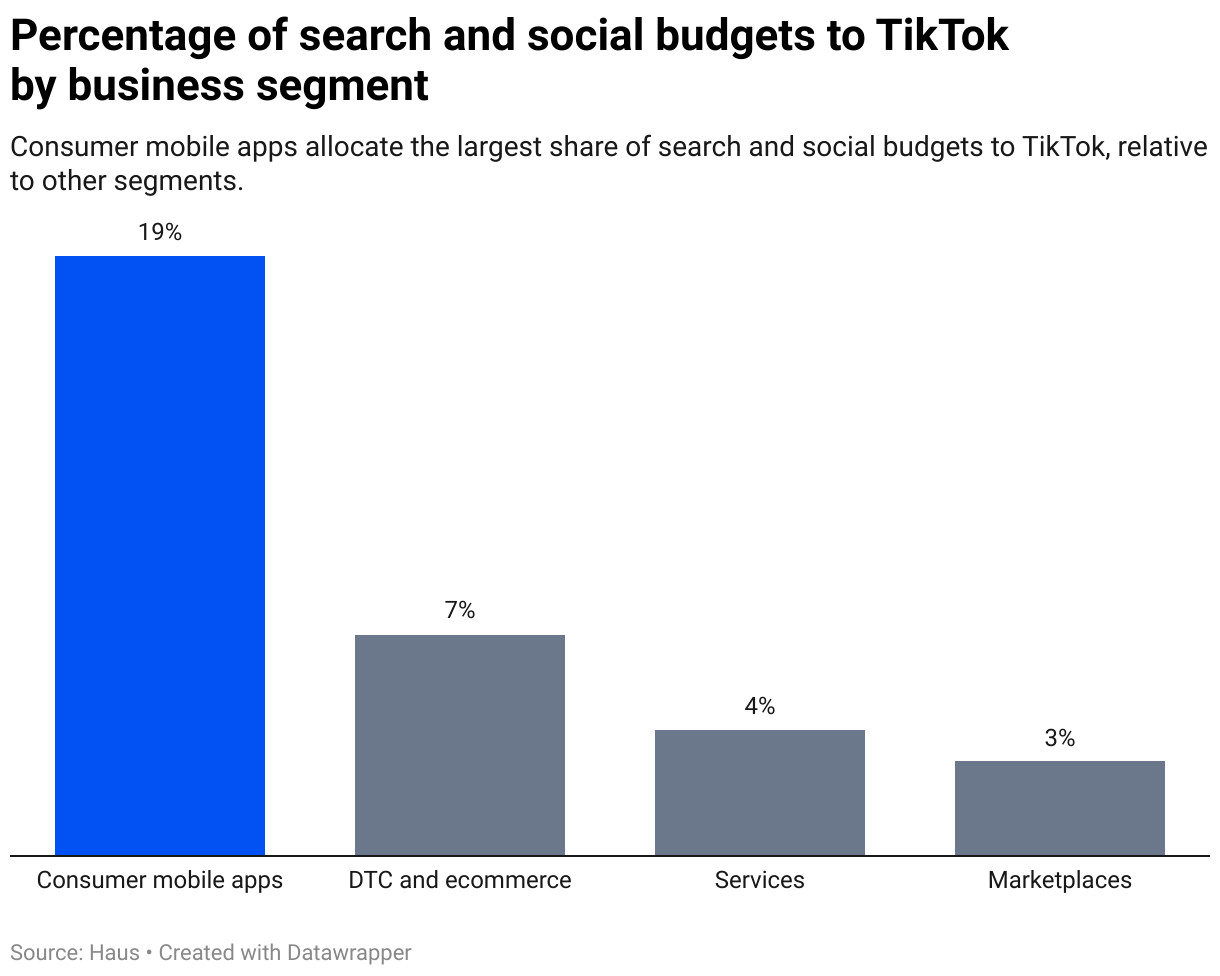
Looking across business segments, data shows that app-based and B2C (business-to-consumer) brands allocate the largest share of search and social budgets to TikTok, relative to other segments. We see that on average, this segment devotes 19% of their search and social spend to TikTok.
How brands can act on these findings

What’s a brand to do with all of this data, and how can you take these learnings and apply them to your business? We recommend keeping these key things in mind:

  • Match TikTok’s strengths to your business. Brands that scale TikTok successfully share several common characteristics: Low-friction offers, simple value propositions, and Gen Z-friendly positioning. Evaluate your potential TikTok fit by audience and offering.
  • Plan for delayed impact. TikTok’s influence builds over time, often paying off after a marketing activity ends. Extend your experiment’s observation window and resist the urge to cut spend too early.
  • Pair TikTok with promotions. TikTok primes audiences and captures demand ahead of promotional or seasonal windows (ahem, Black Friday). Use the platform to build momentum ahead of a key sales period.
  • Optimize for omnichannel lift. TikTok drives meaningful incremental value off-platform. Track omnichannel KPIs (retail, Amazon, DTC, etc.) so you can evaluate business impact holistically.
  • Convert curiosity. Brands that simplify their value proposition into short clips can win big. Prioritize creative that clearly spells out benefits to your audience, and make sure you can capitalize on audience interest with fast time-to-value on the other side.

Last but not least: Experiment your way towards TikTok efficiency. Every brand is different – what works for one brand may not work for another. Use continuous experimentation to your advantage and find the optimal spend level for your business. 

And with that, we’re back off to scrolling #ForYou – purely for research, of course.

Subscribe to our newsletter

The TikTok Report

From the Lab
Dec 4, 2025

Can TikTok scale? How much omnichannel impact does TikTok have? Haus’ analyses of hundreds of TikTok incrementality tests answers these questions and more.

Causal Intelligence: How AI Works in Haus

From the Lab
Nov 21, 2025

Haus' AI-driven platform unleashes scientific rigor, reduces manual errors, and makes complex analytics accessible and actionable for every marketer.

Why Identification Matters: Changing How We Think About MMM

From the Lab
Nov 11, 2025

Identification is all about teasing out real causal relationships between tactics and outcomes — and it's the backbone of Haus’ Causal MMM.

How are incrementality experiments different from A/B experiments?

Education
Nov 5, 2025

Use A/B testing to optimize and incrementality testing to prove impact. Dive into differences, use cases, and how to pick the right test.

How Traditional Marketing Mix Modeling (MMM) Works in 2025 — and Why It’s Evolving

Education
Oct 31, 2025

Traditional marketing mix modeling (MMM) often relies on linear regression to illustrate correlation, not causation — but that's changing.

“It Felt Like A Civic Duty”: Why MMM Specialist Arthur Anglade Joined Haus

Inside Haus
Oct 22, 2025

Haus Principal Measurement Strategy Specialist Arthur Anglade has seen a lot of MMMs in his day. He sits down to explain why Causal MMM is different.

Marketing Measurement: The Fundamentals

Education
Oct 19, 2025

Learn the fundamentals of marketing measurement — from ROAS and MMM to incrementality testing — and discover how to measure true campaign impact.

Introducing Causal MMM

Haus Announcements
Oct 16, 2025

Meet Causal MMM: A marketing mix model that inspires trust, provides clarity, and drives smart marketing investments.

Incrementality: The Fundamentals

Education
Oct 9, 2025

Let's explore incrementality from every angle — what it is, what you can test, and what you need to get started.

World-Renowned Economist Susan Athey Joins Haus As Scientific Advisor

In this Q&A, John Bates Clark Medal-winning economist Susan Athey discusses why Haus is a company she just had to be a part of.

Marketing Attribution: The Fundamentals

Education
Oct 3, 2025

Discover what marketing attribution is, how it works, its pros and cons in 2025, and why incrementality testing provides a more precise measure of ROI.

When Is Branded Search Worth the Investment?

From the Lab
Sep 29, 2025

Our large-scale analysis of real-world, branded search incrementality experiments unpacks when branded search is most effective and how best to leverage it.

Can You Measure The Incrementality of Out-Of-Home (OOH) Marketing?

Education
Sep 26, 2025

Experiments reveal causality and establish the ground truth for cross-channel decision-making — even when it comes to OOH campaigns.

How Hoon Hong Uses Testing To Help Haus Customers Sharpen Their Storytelling

Inside Haus
Sep 23, 2025

Learn how Haus Measurement Strategist Hoon Hong uses incrementality tests to sharpen brands' storytelling and connect with key audiences.

Trust In, Trust Out: Why An MMM Built on Experiments Yields More Accurate Results

Education
Sep 17, 2025

Traditional MMM fails on bad data. Learn how Haus treats experiments as ground truth, taming noise and multicollinearity for trustworthy guidance.

What To Test in Q4: Advice from Haus Experts

From the Lab
Sep 16, 2025

Haus experts offer four useful, non-obvious incrementality tests that can prepare you for the busiest period of the marketing calendar.

Marketing Mix Modeling (MMM) Fundamentals: A Modern Guide

Education
Sep 15, 2025

Explore key concepts, benefits, and practical steps around MMMs — helping you measure and optimize marketing effectiveness.

Incrementality Experiments: A Comprehensive Guide

Education
Sep 4, 2025

We explore incrementality experiments from all angles — what they are, why they matter, and how they translate into business impact.

Optimizing Meta Ads: A Playbook for Brands

Education
Aug 15, 2025

From balancing the funnel to optimizing creative, our new guide has data-backed tips for improving performance on Meta.

Is Meta Incremental?

Education
Aug 13, 2025

We analyzed 640 Meta experiments on the Haus platform, revealing key insights into Meta's incrementality.

Geo Experiments: The Fundamentals

Education
Aug 7, 2025

Explore geo experiments from all angles — what they are, why they matter, and how you can use them to measure incremental impact.

GeoFences: Precise Geographic Control for Marketing Experiments

From the Lab
Aug 6, 2025

GeoFences enable you to exclude markets from your test that aren’t relevant to your business — helping you focus more deeply on the ones that are.

MMM Software: What Should You Look For?

Education
Aug 5, 2025

We discuss some of the key questions to ask a potential MMM provider — and the importance of prioritizing causality.

The Meta Report: Lessons from 640 Haus Incrementality Experiments

From the Lab
Jul 28, 2025

An exclusive Haus analysis show Meta is incremental in most cases — but is the platform's move toward automation improving incremental efficiency?

When Is It Time To Start Incrementality Testing?

Education
Jul 23, 2025

At our Open Haus AMA, a customer asked us: “How do you know when a brand is at the scale where investing in an incrementality tool makes sense?”

Incrementality Testing: How to Choose the Best Tool

Education
Jul 14, 2025

Whether you’re actively evaluating incrementality platforms or simply curious to learn more, consider this checklist your first stop.

Why Incrementality? (And How to Start Testing)

Education
Jul 11, 2025

In our recent Open Haus AMA, we were asked why incrementality has become such a buzzword in marketing. Let's dive in.

Run Cleaner, More Accurate Holdout Tests with Haus Commuting Zones

From the Lab
Jul 9, 2025

Based on open source mobility data collected from mobile phone GPS data, Haus Commuting Zones minimize spillover and improve test accuracy.

What's The Difference Between Test-Calibrated MMM and Causal MMM?

Education
Jul 7, 2025

Sometimes used interchangeably, it’s worth clearly distinguishing between these two approaches and what they accomplish.

Incrementality Experiments: Best Practices and Mistakes to Avoid

Education
Jul 1, 2025

Incrementality testing requires proper design and intentional analysis. Let's walk through some best practices (and potential mistakes).

How An Applied Math Professor Turns Her Expertise Into Impact at Haus

Inside Haus
Jun 26, 2025

We talked to Senior Technical Fellow Vanja Dukic about her journey to Haus and how Haus lets academics translate their knowledge into action. 

Haus Launches Fixed Geo Tests to Measure Billboards, Regional, and OOH Activations

Haus Announcements
Jun 23, 2025

Haus’ exclusive Fixed Geo Tests enable marketers to rigorously measure campaigns that are traditionally difficult to quantify.

Incrementality vs. Attribution: What's The Difference?

Education
Jun 20, 2025

Dive into the key differences between attribution and incrementality — how each approach works, when they're useful, and key pros and cons.

Building An Incrementality Practice: A Practical Guide

Education
Jun 13, 2025

Building an incrementality practice is vital for any brand that's trying to improve decision making. Let's explore how to get started.

How Victoria Brandley Went from Early Haus Customer to Haus Measurement Strategist

Inside Haus
Jun 9, 2025

Measurement Strategist Victoria Brandley walks us through her full-circle journey to Haus and how she became an incrementality believer.

Assembling A Marketing Measurement Plan

Education
Jun 6, 2025

Let’s walk through how to build a marketing measurement plan that puts experimental data at the center.

What Brands Should Be Thinking About In Advance of Prime Day 2025

From the Lab
Jun 5, 2025

Our Measurement Strategists explain which tests can make a difference as you prep for Prime Day 2025.

Incrementality Testing vs. Traditional MMM: What's The Difference?

Education
May 30, 2025

Let's explore some of the differences between traditional media mix modeling and incrementality testing.

Optimizing Your Paid Media Mix in Economic Uncertainty: Your 5-Step Playbook

Education
May 26, 2025

When macroeconomic conditions shift, marketers should proactively partner with finance, understand how budgets may change, and test for efficiency.

Incrementality Testing: The Fundamentals

Education
May 22, 2025

Incrementality testing isolates true campaign impact — giving you clarity, confidence, and a case your CFO will love.

Marketing Measurement: What to Measure and Why

Education
May 5, 2025

This guide outlines the metrics, testing methods, and proven frameworks you can use to measure marketing effectiveness in 2025.

Why An Econometrics PhD Left Meta To Tackle Big Causal Questions at Haus

Inside Haus
May 2, 2025

Senior Applied Scientist Ittai Shacham walks us through life on the Haus Science team and the diverse expertise needed to build causal models.

What You’re Actually Measuring in a Platform A/B Test

Education
May 1, 2025

Platform creative tests may not meet the definition of a causal experiment, but they can be performance optimization tool within the bounds of the algorithm.

Beyond the Buzzwords: Why Transparency Matters in Incrementality Testing

From the Lab
Apr 29, 2025

Brands need to have complete information to make responsible decisions like their company depends on it.

Should I Build My Own MMM Software?

Education
Apr 11, 2025

Let's unpack the pros and cons of building your own in-house marketing mix model versus working with a dedicated measurement partner.

Why An Analytics Expert Left Agency Life to Become Haus' First Measurement Strategist

Inside Haus
Apr 10, 2025

Measurement Strategy Team Lead Alyssa Francis sat down with us to discuss how she pushes customers to challenge the testing status quo.

Understanding Incrementality Testing

Education
Apr 2, 2025

Fuzzy on some of the nuances around incrementality testing? This guide goes deep, unpacking detailed examples and step-by-step processes.

How to Know If An Incrementality Test Result Is ‘Good’ – And What to Do About It

Education
Mar 21, 2025

Plus: What to do when a test result is incremental but not profitable, and a framework for next steps after a test.

Why A Leading Economist From Amazon Came to Haus to Democratize Causal Inference

Inside Haus
Mar 19, 2025

We sit down with Principal Economist Phil Erickson to talk about Haus’ “unhealthy obsession” with productizing causal inference.

Haus x Crisp: Measure What Matters in CPG Marketing

Haus Announcements
Mar 13, 2025

When real-time retail data meets incrementality testing, CPG brands can finally measure what’s working and optimize ad spend with confidence.

Why Magic Spoon’s Former Head of Growth Embraces Incrementality at Haus

Inside Haus
Mar 10, 2025

In our first episode of Haus Spotlight, we speak to Measurement Strategist Chandler Dutton about the in-the-weeds approach Haus takes with customers.

Do YouTube Ads Perform? Lessons From 190 Incrementality Tests

From the Lab
Mar 6, 2025

An exclusive Haus analysis shows YouTube often delivers powerful new customer acquisition and retail halo effects that traditional metrics miss.

Getting Started with Causal MMM

Education
Feb 24, 2025

Causal MMM isn’t rooted in historical correlational data – it’s rooted in causal reality.

A First Look at Causal MMM

Haus Announcements
Feb 19, 2025

Causal MMM is a new product from Haus founded on incrementality experiments. Coming 2025.

Would You Bet Your Budget on That? The Case for Honest Marketing Measurement

From the Lab
Feb 14, 2025

Acknowledging uncertainty enables brands to make better, more profitable decisions.

Getting Started with Incrementality Testing

Education
Feb 7, 2025

As the customer journey grows more complex, incrementality testing helps you determine the true, causal impact of your marketing.

Matched Market Tests Don't Cut It: Why Haus Uses Synthetic Control in Incrementality Experiments

From the Lab
Jan 28, 2025

Haus’ synthetic control produces results that are 4x more precise than those produced by matched market tests.

Incrementality School, E6: How to Foster a Culture of Incrementality Experimentation

Education
Jan 16, 2025

Having the right measurement toolkit for your business is only meaningful insofar as your team’s ability to use that tool.

Geo-Level Data Now Available for Amazon Vendor Central Brands

Industry News
Jan 6, 2025

Vendor Central sellers – brands that sell *to* Amazon – can now use Haus to measure omnichannel incrementality.

2025: The Year of Privacy-Durable Marketing Measurement

From the Lab
Dec 28, 2024

Haus incrementality testing doesn’t rely on pixels, PII, or other data that may be vulnerable to privacy regulations.

Meta Shares New Conversion Restrictions for Health and Wellness Brands

Industry News
Nov 25, 2024

Developing story: Starting in January 2025, some health and wellness brands may not be able to measure lower-funnel conversion events on Meta.

Incrementality School, E5: Randomized Control Experiments, Conversion Lift Testing, and Natural Experiments

Education
Nov 21, 2024

Sure, the title's a mouthful – but attributing changes in data (ex: ‘my KPI went up') to certain factors (ex: ‘we increased ad spend’) is hard to do well.

Incrementality School, E4: Who Needs Incrementality Testing?

Education
Nov 14, 2024

As brands' marketing strategies grow in complexity, incrementality testing becomes increasingly consequential.

Incrementality School, E3: How Do Brands Measure Incrementality?

Education
Nov 7, 2024

Traditional MTAs and MMMs won't measure incrementality – but geo experiments reveal clear cause, effect, and value.

Incrementality School, E2: What Can You Incrementality Test?

Education
Oct 31, 2024

Haus’ Customer Marketing Lead Maddie Dault and Success Team Lead Nick Doren dive into what you can incrementality test – and why now's the time.

Incrementality School, E1: What is Incrementality?

Education
Oct 24, 2024

To kick off our new Incrementality School series, three Haus incrementality experts weigh in describing a very fundamental concept.

Inside the Offsite: Why Haus?

Inside Haus
Oct 17, 2024

At this year's offsite, we dove into why – of all the companies, options, and career paths out there – our growing team chose Haus.

Haus Named One of LinkedIn's Top Startups

Inside Haus
Sep 25, 2024

A note from Zach Epstein, Haus CEO.

Google Announces Plan to Migrate Video Action Campaigns to Demand Gen

Industry News
Sep 6, 2024

The news leaves advertisers swimming in uncertainty — which is why it’s so important to test before the change.

Conversion Lag Insights: How Haus Tests Can Help Optimize Q4 Budgets

From the Lab
Sep 5, 2024

Post-treatment windows offer a unique glimpse into the lingering impacts of advertising campaigns after they’ve concluded.

PMAX Experiments Revealed: Including vs. Excluding Branded Search Terms

From the Lab
Aug 20, 2024

We analyzed experiments from leading brands to understand the incremental impacts of including vs. excluding branded terms in PMAX campaigns.

CommerceNext Session Recap: How Newton Baby Uses Incrementality Experiments to Maximize ROI

From the Lab
Aug 9, 2024

“We ran the test of cutting spend pretty significantly and it turns out a lot of that spend was not incremental,” says Aaron Zagha, Newton Baby CMO.

Introducing Causal Attribution: Your New Daily Incrementality Solution

Causal Attribution syncs your ad platform data with your experiment results to provide a daily read on which channels drive growth.

Haus Announces $20M Raise Led by 01 Advisors

Haus Announcements
Jul 30, 2024

With this additional support, Haus is well-positioned to deepen our causal inference capabilities and announce a new product: Causal Attribution.

3 Ways to Perfect Your Prime Day Marketing Strategy

Education
Jun 26, 2024

Think Amazon ads are the only effective marketing channel for Prime Day? Think again.

Maximize Your Q4 Growth With 4 High-Impact, Low-Risk Tests

Education
Nov 8, 2023

Not testing during your busy season may be costing you more than you think.

Why Maturing Direct to Consumer Brands Need to Run Incrementality Tests

Education
Sep 15, 2023

The media strategy that gets DTC brands from zero to one does not get them from one to ten.

5 Signs It’s Time to Invest in Incrementality

Education
Aug 9, 2023

5 common signs that indicate it is definitely time to start investing in incrementality.

$17M Series A, Led by Insight Partners

Haus raises $17M Series A led by Insight Partners to build the future of growth intelligence.

Why Meta's “Engaged Views” Is a Distraction, Not a Solution

Industry News
Jul 25, 2023

While additional data can be useful, we must question whether this new rollout is truly a solution or merely another diversion.

Why You Need a 3rd Party Incrementality Partner

Education
Jul 6, 2023

Are you stuck wondering if you should be using 3rd party incrementality studies, ad platform lift studies, or trying to design your own? Find out here.

iOS 17 Feels Like iOS 14 All Over Again. What It Means for Growth Marketing…And Does It Matter Anymore?

Industry News
Jun 12, 2023

A single press release vaguely confirmed that Apple will continue its assault on user level attribution. Here, I unpack what I think it means for growth marketing.

How Automation Is Transforming Growth Marketing

Education
May 30, 2023

As platforms force more automation, the role of the media buyer is evolving. Read on to learn what to expect and what levers are left to pull.

Statistical Significance Is Costing You Money

From the Lab
Apr 13, 2023

It is profitable to ignore statistical significance when making marketing investments.

The Secret to Comparing Marketing Performance Across Channels

Education
Mar 2, 2023

While incrementality is better than relying on attribution alone, comparing them as-is is challenging. Thankfully, there’s a better way to get an unbiased data point regardless of the channel.

Your Attribution Model Is Precise but Not Accurate - Here’s Why

Education
Feb 8, 2023

Learn which common marketing measurement tactics are accurate, precise, neither or both.

How to Use Causal Targeting to Save Money on Promotions

Education
Feb 1, 2023

Leverage causal targeting to execute promotions that are actually incremental for your business.

Are Promotions Growing Your Business or Losing You Money?

Education
Feb 1, 2023

Promotions, despite their potential power and ubiquity, are actually hard to execute well.

User-Level Attribution Is Out. Geo-Testing Is the Future.

Education
Jan 27, 2023

Geotesting is a near-universal approach for measuring the incremental effects of marketing across both upper and lower funnel tactics.

The Haus Viewpoint

Inside Haus
Jan 18, 2023

We are building Haus to democratize access to world-class decision science tools.