How to Tie a Super Bowl Ad to Business Outcomes
The Haus playbook for measuring tentpole brand campaigns

Feb 4, 2026
.avif)
Any time you’re making a marketing investment, you want to be data-driven about its impact on the business. But sometimes it’s much harder to draw a line between “Splashy spot at the Super Bowl” to “Business outcome from that ad that wouldn’t have happened otherwise.”
But – there are ways to do this! Marketing has come a long way from “Millions of people watch the Super Bowl every year, it’s gotta be good for something” to actually being able to quantify impact to the business (or, just as importantly, lack of impact to the business).
At Haus, we work with brands day in and day out to help them do just this. Yes, lots of brands are focused on bottom- or mid-funnel campaigns where if you put $X in in February, you’ll get $Y out in February – but we work with large enterprises all over the world to help them measure the unmeasurable. Here’s how we do it.
What’s an ‘unmeasurable?’
“When people say OOH, podcast, a Super Bowl commercial, or a sponsorship is ‘unmeasurable,’ what they usually mean is they can’t tie it cleanly to revenue,” explains Enterprise Solutions Lead Tom O’Bara. “Haus helps by quantifying incremental revenue (or conversions) beyond impressions, clicks, or other brand metrics.”
Even the most incrementality-forward marketing teams can get intimidated when it comes to measuring non-geo-segmentable media like influencer creative, out-of-home (OOH) activations, programmatic podcasts, or linear TV. These are hard-to-measure advertising channels where traditional MTA, traditional MMM, and experiments struggle – but it can be done.
Unmeasurables differ from other upper-funnel campaign types like Connected TV (CTV), YouTube Awareness, Meta Prospecting, etc. because they cannot be geo-segmented into geo-experiments like the latter. Without the ability to run geo-experiments against them, businesses can feel in the dark on how to tie upper-funnel, awareness-driving marketing campaigns to business outcomes.
OK, so your Super Bowl ad got over a hundred million views… and? What happened to the business that you can prove happened because of the ad? You can see how this gets thorny. Whereas once upon a time “views” or “impressions” may have been an acceptable metric, those kinds of figures no longer justify multi-million dollar investments.
How Haus measures the unmeasurable
To understand the Haus POV on the unmeasurable, it’s helpful to first understand how we approach incrementality experiments generally.
“Our starting question for any big brand moment is: ‘How much additional business did this actually create vs. what would have happened anyway?’” explains Tom. “From there, we pick the right experimental design.”
Haus partners with brands on different types of experiments, and the right type depends on 1) what you’re trying to measure and 2) your experiment design constraints.
What you’re trying to measure
Think about the KPI that is most important to you.
For a digital app, it might be downloads or subscriptions. For a physical product, this might look like new customers, total sales, or average order value. What’s most important is that it’s an indicator of a desired business outcome. Occasionally, the KPI you choose to focus on may be an indirect indicator rather than a direct indicator – the Haus team can help you work through these details.
Experiment design constraints
The nature of your advertising determines the right experiment design for your initiative. Think about it like this:
If you’re running a national campaign and can select regions to turn off the ad, GeoLift is your go-to. For geo‑targetable channels (Meta, Google, CTV), Haus enables brands to run geo experiments where some regions get the activation and others don’t. The output is a read on the incremental lift to sales and the incremental return on ad spend (iROAS) of that marketing spend.
For localized campaigns like OOH or regional TV, where the markets are pre‑selected, Haus works with businesses to use Fixed Geo Tests, building a synthetic control group of comparable regions and measuring divergence in revenue during the campaign.
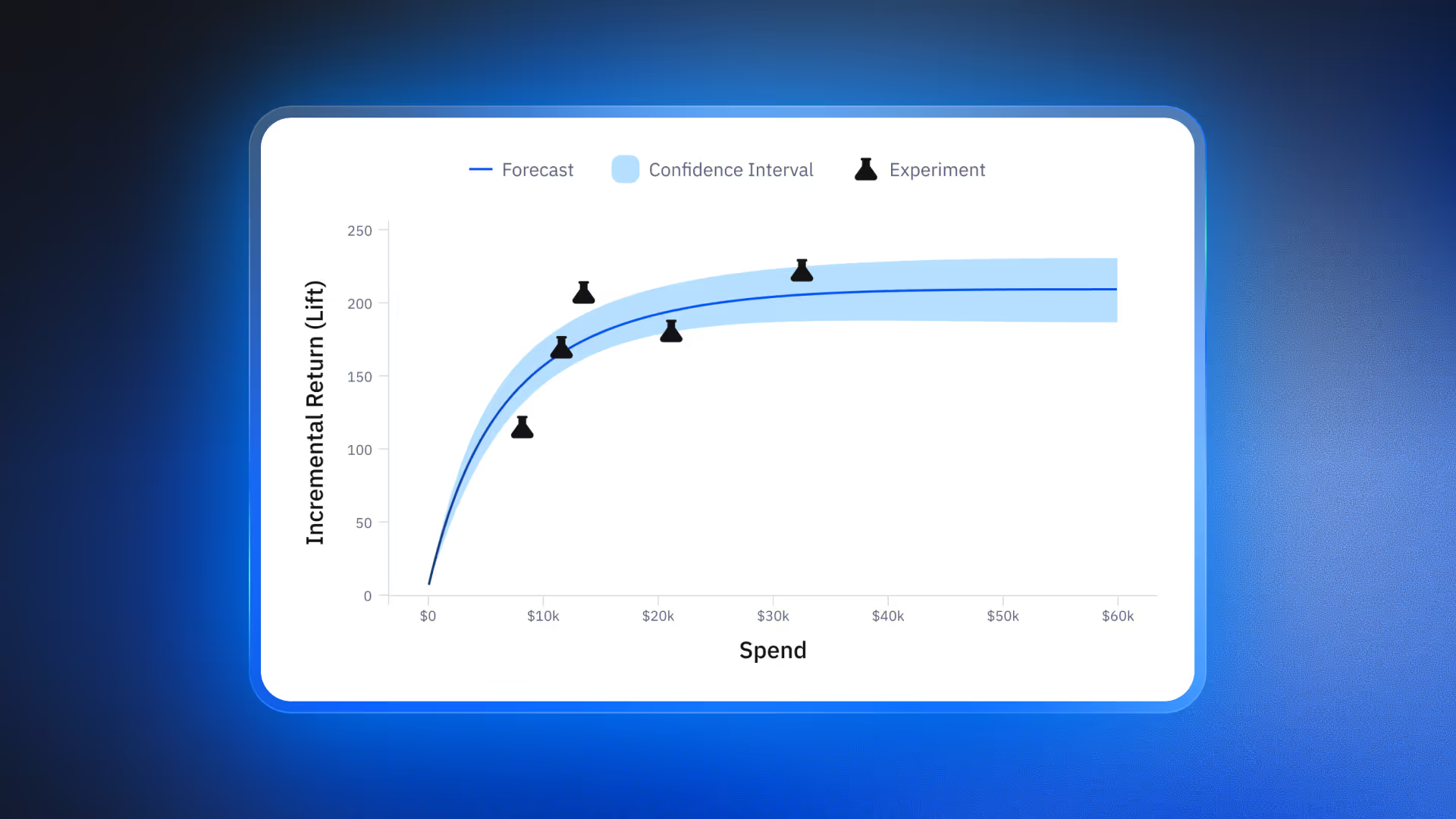
For truly national, one‑off moments where you can’t carve out a clean holdout, like a Super Bowl spot or World Cup sponsorship, Haus partners with businesses to run Time Tests. We forecast what sales should have been without the campaign and then measure how far actuals beat that baseline – in terms of incremental sales – with clicks, reach, and engagement used to help explain why we saw what we saw.
Time Tests are best for national, high‑impact campaigns when a business cannot split marketing into test and control groups. They’re more directional and work best when a big enough change — during an otherwise business‑as‑usual period — can plausibly move top‑line metrics beyond normal noise.
How to measure the ROI of a Super Bowl campaign
So, what if you’re trying to measure whether a Super Bowl spot causes business outcomes that wouldn’t have happened otherwise?
“With the Super Bowl, Time Tests look at your historical data around the same timeframe to adjust for seasonality, and model what would normally happen to your business around Super Bowl time,” explains Haus Enterprise Measurement Strategy Manager Jake Moskowitz. “We then leverage the difference between that projection and your actual results to determine the causal impact of your Super Bowl investment.”
Enterprise Measurement Strategy Lead Kevin Keeley adds, “There are a few things you should look out for when you run Time Tests to ensure that they are going to drive the strongest read possible – for example, your business needs to be pretty much BAU otherwise – but it's really useful when you know you’re going to run the marketing anyway.”
In advance of measuring a hard-to-measure campaign, Haus partners with businesses well before the activation goes live. Here are some of the most important details to square away:
Clarify the business decision. Are you trying to justify the size of the Super Bowl bet, decide whether to renew it, or understand the right level of investment in big tentpoles vs. always‑on? This drives what to measure and at what granularity.
Map the media plan to test designs. For each component of a marketing campaign (linear, digital video, paid social, OOH, CRM), Haus partners with businesses to decide where geo testing is feasible vs. where we’ll need a time‑series read.
Lock KPIs and data requirements. Align early on which revenue KPIs (store, online, key categories, retail partners) you’ll use as primary outcomes, and what click/engagement data you’ll want as supporting diagnostics so everything is ready by the time the campaign launches.
Define a learning agenda across tentpoles. Haus doesn’t treat the Super Bowl (or the World Cup, or March Madness, or the Olympics…) as one‑off science projects. We design them as part of a sequence: Pre‑tentpole tests to calibrate channels and spend levels, in‑flight measurement during the event, and then feed those causal reads into the business’ MMM for future planning.
Measuring the unmeasurable in action
From global enterprises to ecommerce staples, here are three examples of how Haus helps businesses measure the brand awareness and tentpole marketing campaigns that are historically difficult to connect to bottom-line impact.
Phoenix | Super Bowl: Time Test
Running a Super Bowl commercial is one of the boldest bets a brand can make. The audience is massive, the moment is unmissable—and the stakes are high. But after the confetti falls, how do you know if that bet was actually worth it?
That was Phoenix’s challenge when the Canadian men’s telehealth brand decided to debut high-impact creative during the Super Bowl, after weeks of advertising through the NFL playoffs. Traditional lift tests weren’t an option — you can’t create clean holdouts during a one-time tentpole like the Super Bowl — yet the team still needed to know whether this swing drove real, ROI-positive growth.
To solve this, Phoenix and Haus ran a Time Test, using Haus’s proprietary forecasting to predict key metrics for the Super Bowl window and then compare that forecast to actual performance. The result: the Super Bowl spot drove a 26% lift in signups in just one week, at a cost per incremental acquisition that stayed within Phoenix’s efficiency thresholds. By breaking out results by product category and quickly extending the winning creative to YouTube, Phoenix turned what could have been an unmeasurable brand moment into a clear, validated success.
Pernod | Sphere: Fixed Geo Test
Lighting up the Las Vegas Sphere with your brand colors — it doesn’t get much more flashy than that. But can you measure it?
That was Pernod Ricard’s challenge to Haus when they launched their immediately legendary St. Patrick’s Day campaign. And it wasn’t just The Sphere that would be coated in Jameson Irish whiskey logos. They also ran brand activations in New York’s Times Square and the Chicago Riverwalk.
To measure impact, Pernod Ricard and Haus designed a Fixed Geo Test. This involved building a synthetic control group of regions that mimicked the behavior of the treated regions (NY, IL, NV). Then they measured the divergence of the groups during the campaign to get a read on the actual business impact.
The campaign drove a 4.7% lift in depletions (product shipped from distributor to retailer). This proved a direct link between the activation and increased product movement, turning what was once a “brand buzz” story into a quantifiable success. Finally, they connected marketing activations to actual sales, rather than just impressions.
Osea | Podcast: Geo Experiment
Listeners form tight bonds with their favorite podcasters, making podcasts a potent channel for telling your brand’s story. OSEA, a clean skincare brand, naturally wanted to show up on podcasts, so they launched their first programmatic podcast ad campaign. But how would they measure revenue impact across multiple channels?
They worked with Haus to launch a 2-cell geo experiment that measured performance across Shopify, Ulta, Nordstrom, and Amazon. The results showed podcasts delivered a 1.8% revenue increase on Shopify, exceeding their Shopify iROAS goal by 54%. And across all sales channels, they exceeded their omnichannel iROAS goal by 4x. This gave OSEA the confidence to scale investment in the channel.
Had they only had insight into DTC, they wouldn’t have really understood the true impact of programmatic podcast ads — and they wouldn’t have been able to confidently move forward with their investment. However, getting insight into multiple sales channels gave them a much deeper understanding of performance.
The bottom line on measuring hard-to-measure brand activations
Brand marketing can be tied to business outcomes – and should be. Through experimentation, marketing and finance teams can determine causality and make the best investment decisions for their business.
“The end result is that even for historically ‘unmeasurable’ investments like a Super Bowl ad, March Madness sponsorship, or a massive OOH takeover, we can come back to our partners and their stakeholders with a revenue‑first answer and say ‘here’s how much incremental business this drove, here’s the efficiency, and here’s how we’d scale or reshape it next time,’ stresses Tom.
Every business is different — we say it often, and we’ll say it again: Every business should test for itself. What works for a competitor or comparable business may not work for you. Even the same channel can produce vastly different results depending on creative, audience, and execution. But with the right tools, experiments, and commitment to causality, you can measure the unmeasurable and answer the questions that have long haunted brand marketers.
Subscribe to our newsletter
Article Authors

Emily K. Schwartz leads Content and Brand at Haus. Her career began in journalism (NPR, Politico, The Washington Post, several magazines) before shifting into product management (AddThis/Oracle Data Cloud, Capital One, several startups) and ultimately comms, content, and brand. Originally from outside of Philadelphia, Emily currently lives in Northern Virginia and enjoys all things Philadelphia sports, tennis, travel, and style.
.png)
.png)


.png)
.png)

.png)

.avif)


.avif)
.avif)

.avif)
.avif)
.avif)
.avif)
.avif)


.avif)


.avif)


.avif)
.avif)
.avif)
.png)
.png)
.avif)


.avif)
.avif)
.avif)
.avif)
.avif)
.avif)

.avif)

.avif)

.avif)

.avif)
.avif)
.avif)
.avif)
.avif)


.avif)
.avif)
.avif)
.avif)

.avif)
.avif)
.avif)

.avif)

.avif)
.avif)
.avif)
.avif)

.avif)


.avif)
.avif)


.avif)
.avif)
.avif)

.avif)
.avif)
.avif)
.avif)
.avif)
.avif)



.png)
.avif)
.png)
.avif)