AI marketing measurement: What do you need in your stack?
Most marketing teams are spending money on measurement. The harder question is whether they're measuring the right things, with the right tools, in a way that actually leads to better decisions.
May 24, 2026

Most marketing teams are spending money on measurement. The harder question is whether they're measuring the right things, with the right tools, in a way that actually leads to better decisions.
The answer usually isn't "more data." It's better signal — and increasingly, AI plays a central role in getting there.
The core problem with traditional measurement
Marketing measurement involves three key phases: collecting data, analyzing it, then acting. Together, these help you understand how well your marketing efforts are performing. That sounds straightforward. In practice, it breaks down fast.
The problem is traditional attribution. You could end up attributing a conversion to a certain campaign, but that conversion might have happened anyway, with or without that campaign.
Click-based attribution is often misleading and inaccurate. It can miss conversions influenced by upper-funnel channels where digital fingerprinting is spotty, like YouTube, CTV, and OOH. It doesn't capture the effect of marketing on retail sales, and it can also over-report when digital campaigns find customers who were already incrementally influenced by another campaign.
The result is a stack built on numbers that don't reflect reality. Budgets shift toward channels that look efficient but aren't. Channels that actually work get defunded.
What a modern measurement stack actually needs
Most modern marketing teams have a measurement stack that incorporates several different flavors of measurement: platform metrics, multi-touch attribution, incrementality testing, and maybe some form of marketing mix model. Each layer answers different questions.
Platform metrics give you speed and granularity but lack objectivity. Traditional multi-touch attribution attempts to distribute credit across touchpoints, but skepticism toward traditional attribution tools runs rampant.
Marketing mix modeling offers a longer-range view of cross-channel contribution, but traditional MMMs are built on historical correlations, which means they can recommend channels based on patterns that have nothing to do with what's actually driving revenue.
The missing piece in most stacks is causal measurement: a method that establishes not just that things moved together, but that one thing caused the other.
Incrementality as the foundation
Incrementality experiments show you what would have happened without your marketing. You compare business outcomes between exposed and unexposed groups to isolate the impact of your marketing campaigns.
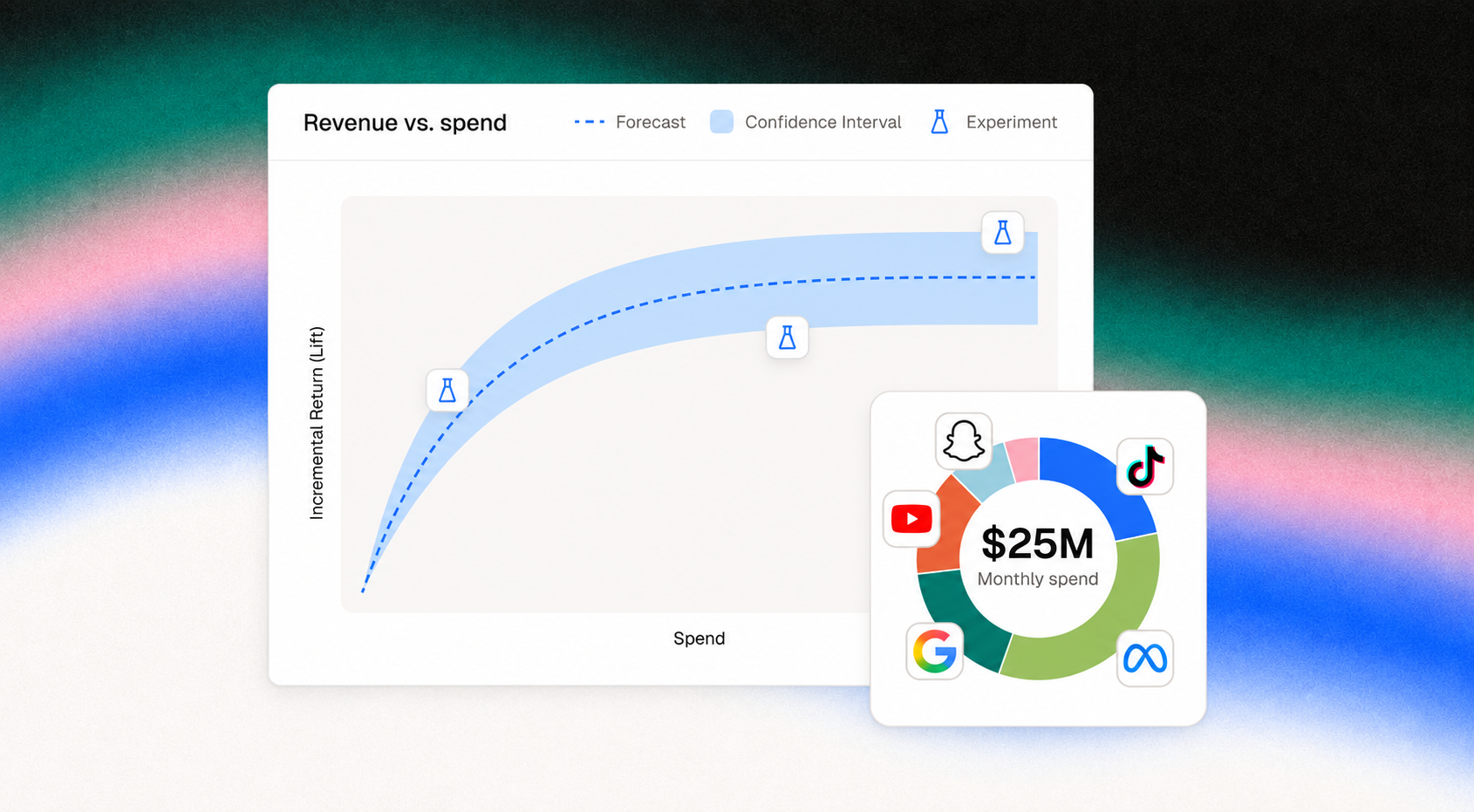
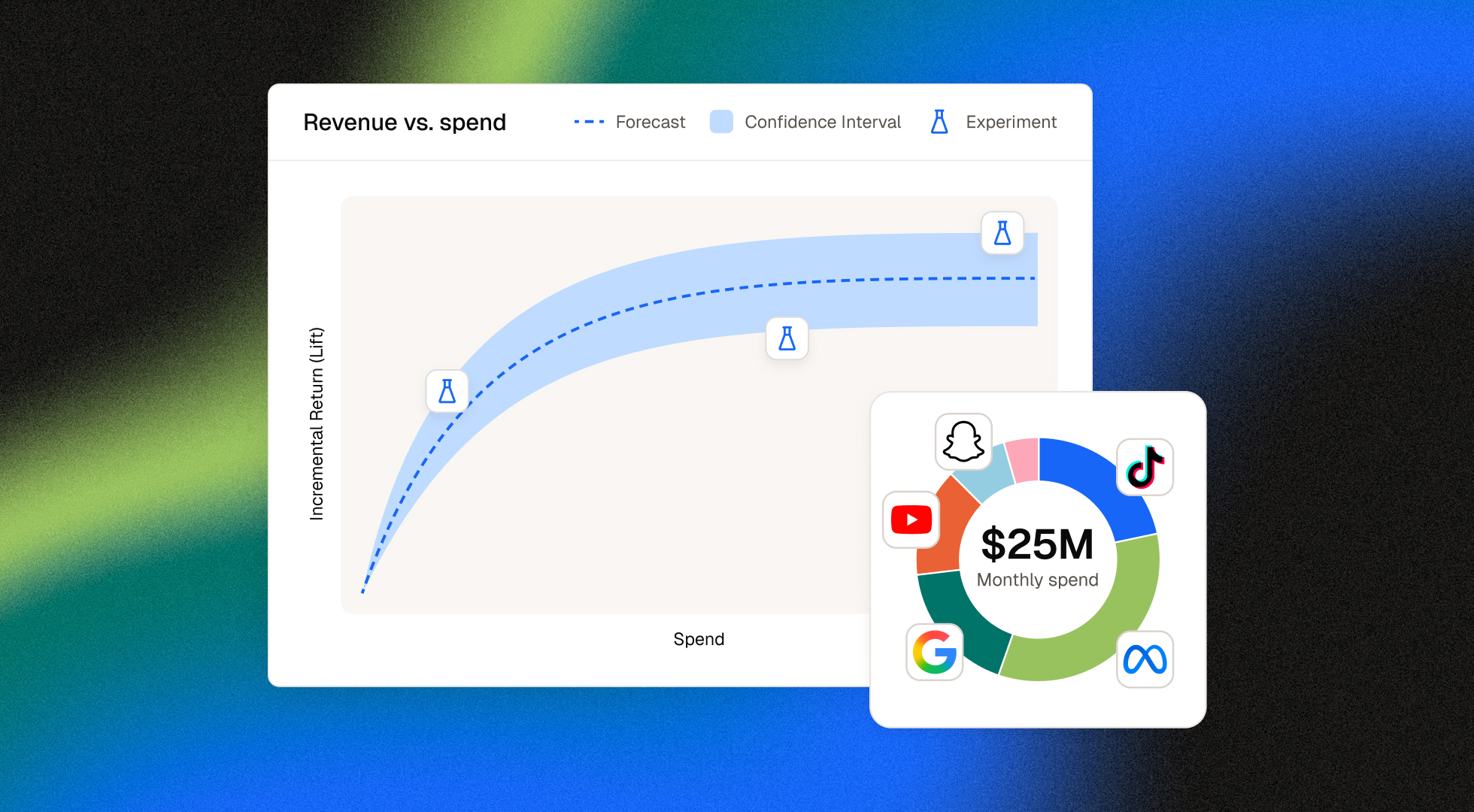
Incrementality experiments identify the marketing activities causing business outcomes by comparing impacts from groups exposed to your marketing against groups who were not. This helps you reveal the true causal impact of every dollar, cut wasted spend, and invest with confidence in the channels that actually drive incremental growth.
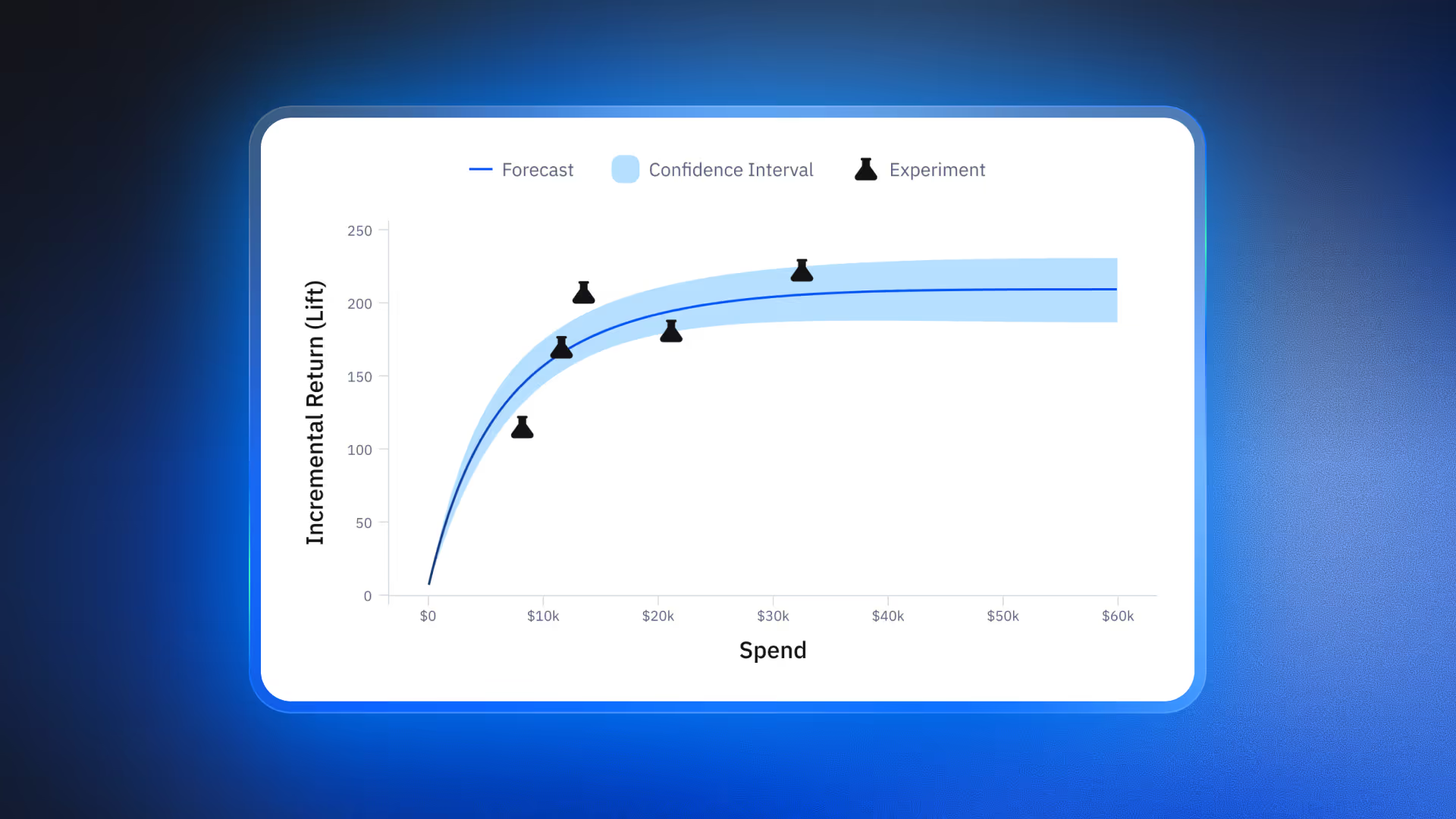
The scope of what you can test is broader than most teams realize. Beyond channel effectiveness, incrementality testing can measure halo effects (like whether ecommerce ads boost retail and Amazon sales), efficiency at different spend levels, the impact of upper-funnel no-click channels like OOH and CTV, and how marketing performance shifts across seasons and promotions.
Geo-based experiments are the predominant method because they allow for clean test and holdout groups without requiring user-level tracking, which matters more as privacy regulations continue to tighten. Haus uses random stratified sampling to assign test and control groups across a country or region, ensuring statistically robust results that are representative of the market.
Where AI fits in
AI's role in measurement isn't about replacing human judgment. It's about removing the sources of noise and error that make experiments unreliable and slow.
Causal Intelligence is Haus’ proprietary approach to embedding advanced artificial intelligence and machine learning throughout the marketing experiment, measurement, and optimization journey. This layer of AI is built upon a foundation of scientific and measurement expertise, with economists working together with an engineering team to ensure that every experiment is rooted in explainable econometrics and causal inference models.
What that looks like in practice: AI automatically runs thousands of placebo tests on every experiment, reducing false positives and increasing confidence in the results. Synthetic controls — a statistical method used to evaluate what would have happened to a group if it had not received a particular treatment — are built for every experiment, establishing more accurate counterfactuals than traditional methods.
AI also automates advanced outlier detection and anomaly handling, preventing extreme data spikes from skewing campaign insights, and providing an unbiased assessment of marketing impact with no human bias toward the best-looking results.
The compounding benefit is speed. What used to require data scientists spending hours or days on manual setup can now be completed in minutes, with more statistical rigor than manual approaches could realistically deliver.
When and where to invest
The right level of investment in measurement depends on the scale and complexity of your marketing program. If you're marketing on a channel or two with a modest budget, a mix of platform-reported metrics and open-source incrementality testing can get you pretty far.
But several signals suggest it's time to invest in a more sophisticated stack. Channel impact gets harder to read when you're running two or more significant paid channels alongside growing organic traffic, partnerships, and PR, and changes in paid spend stop showing up cleanly in topline data. Omnichannel sales complexity compounds this: If a meaningful share of your business happens outside your primary DTC site (through Amazon, retail partners, or other marketplaces), digital attribution tools will fall short. A rough rule of thumb: Once you're spending more than $1M per month on paid marketing, the cost of misallocating dollars becomes significant enough to warrant better measurement.
When traditional MMMs start showing their limits (multicollinearity, opacity, recommendations that don't match what your experiments are telling you), that's the inflection point for an MMM grounded in experimental data rather than historical correlation. With Causal MMM, every experiment you run feeds the model and continuously improves it, and the tests calibrating the model are visible rather than hidden inside a black box.


.jpg)

.png)









.avif)
.avif)

.avif)

.avif)
.avif)
.avif)
.avif)


.avif)


.avif)


.avif)
.avif)
.avif)
.avif)
.png)
.png)
.avif)


.avif)
.avif)
.avif)
.avif)
.avif)
.avif)

.avif)

.avif)

.avif)

.avif)
.avif)
.avif)
.avif)
.avif)


.avif)
.avif)

.avif)
.avif)

.avif)
.avif)
.avif)

.avif)

.avif)
.avif)
.avif)
.avif)

.avif)


.png)
.avif)



.avif)
.avif)
.avif)

.avif)
.avif)
.avif)
.avif)
.avif)
.avif)