How to Turn Your MMM Into A Decision Engine, with Haus’ Hannah Perez
For many enterprise businesses, their traditional MMM is packed with data but not actionable. Here's how Haus' Hannah Perez helps them operationalize MMM and experiments.
Jun 1, 2026
.avif)
Who among us hasn’t bought workout equipment with noble intentions? Maybe you splurged on a fancy treadmill with all the bells and whistles, certain it would be the center of your exercise routine for years to come…but fast forward three years, and that pricey equipment is languishing in the corner. It’s now, functionally, a $1,200 clothes rack.
For some brands, this is similar to their experience with traditional marketing mix modeling (MMM). They knew they needed to implement an MMM, they spent big money on it, and now it's a report they get every six months that doesn't inform their actual day-to-day decisions. It’s packed with historical data about your business, but can’t keep up with the pace of decision-making.
“A lot of enterprise teams have an MMM that's become more of an artifact than a decision-making tool,” says Haus’ Hannah Perez.
As a Solutions Consultant, Hannah is one of the first faces enterprise teams talk to at Haus. It’s her job to learn their problems, then build a roadmap that solves their unique challenges. And one of the most common challenges is operationalizing MMM outputs.
Luckily, she’s seen enough success stories to know it doesn’t have to be this way. With a bit of soul-searching and experiments in the mix, she’s seeing more and more enterprise orgs act on their MMM data and drive real impact. Let’s unpack how.
The three reasons why traditional MMMs go unused
As someone who is talking to enterprise brands every day, Hannah has uncovered three big reasons why teams struggle to turn their MMM into an active part of their decision-making process:
They’re outdated. “Often these models update every six months, maybe quarterly if they're lucky,” says Hannah. “That cadence doesn't match how quickly marketing decisions need to get made today. Brands aren’t committing hundreds of thousands of dollars in a media buy and hoping it works for the next quarter. Budgets are agile now. Shifting dollars across the mix has to be a frequent, consistent practice. And you can't do that well with a model that's only refreshing a couple times a year.”
The use case isn’t always obvious. “MMM has kind of been a catch-all of ‘Let's put as much data as humanly possible into this model and see what the recommendations are,’” says Hannah. “The data they choose to include has inherent bias. Plus, the model becomes so big and noisy, because there are so many inputs and so much data — then you get analysis paralysis.”
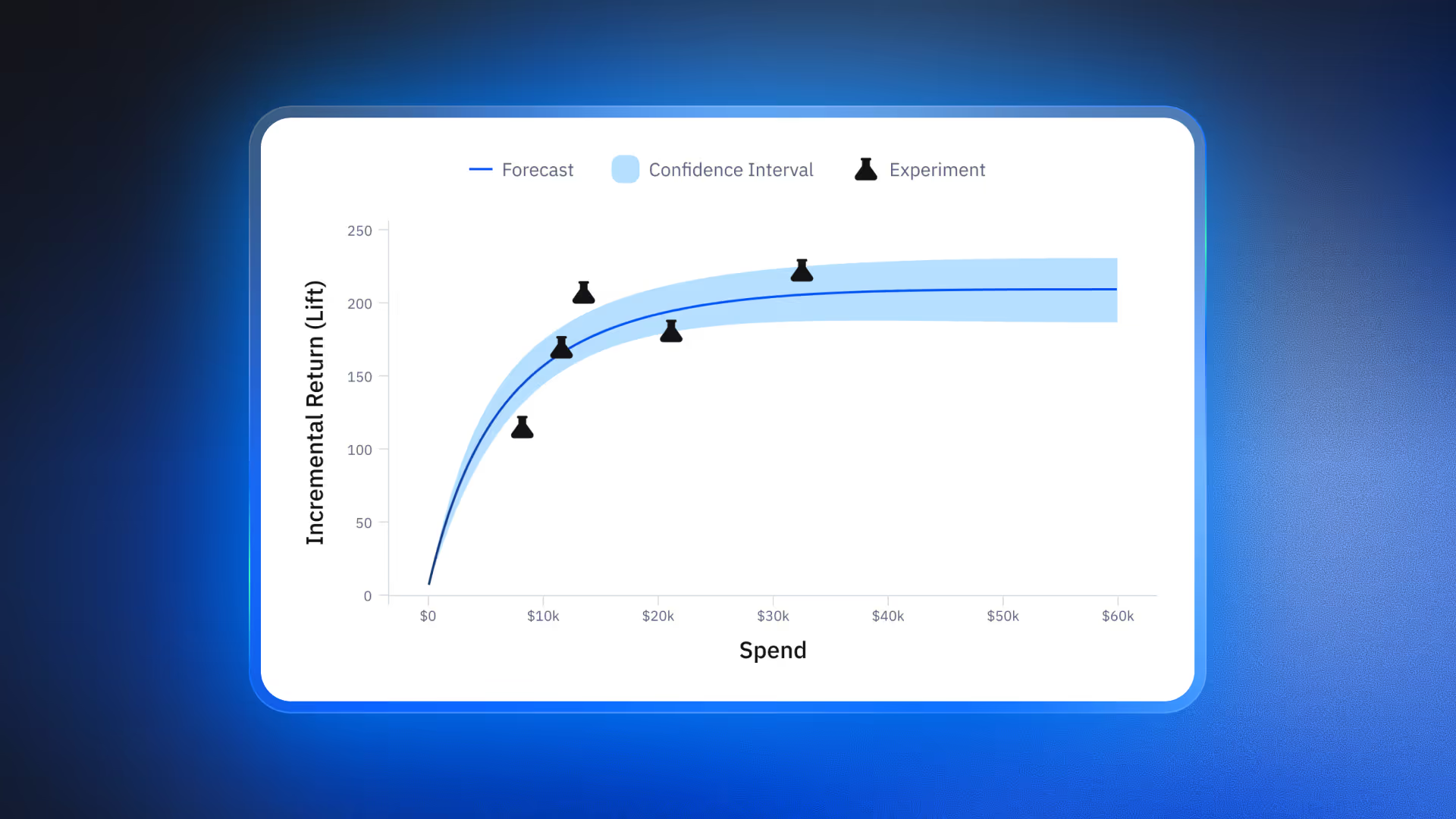
They’re not grounded in experiments. “People have realized that incrementality is the most accurate source of truth, which has peeled back another layer of the challenges with traditional MMMs,” says Hannah. “A lot of traditional MMMs don't take in experiment results. Or if they do, it just kind of nudges things one way or the other. That's fundamentally different from where the market is heading with incrementality testing.”
How to get off the “treadmill” of unactionable MMM
When teams start to air their MMM frustrations, Hannah almost has to play some marketing version of couples therapy. When you first met this MMM, what were you hoping to get out of the relationship? To get to the root of the problem, it’s often a matter of retracing their steps and remembering why they bought an MMM to begin with.
Step 1: Remember the original goal with MMM
“Brands must ask themselves what they want from their MMM,” says Hannah. “And if they’re not using it, they need to figure out what value it currently has within the organization at large, as well as within your respective business unit, channel, or product suite.”
Once you’ve remembered the original goal, it’s a matter of figuring out where your current MMM is (and isn’t) providing answers. Then you can understand what you need to fill in the gaps. Many times, teams end up seeking out something easier and faster than their MMM, leading them to incrementality experiments. Cue step 2!
Step 2: Build your incrementality practice
“More and more teams have a solid understanding of what incrementality testing is and why it works,” says Hannah. “The frustration tends to be around the process of getting it set up, operationalizing it, and creating a consistent practice internally.”
Major enterprises have multiple teams that need to be involved in getting testing off the ground, and internal resourcing, friction and misalignment can stall garnering actual insights. The risk is never acting on test results, or maybe never even getting tests off the ground. Making sure all teams are working in lockstep from experiment hypothesis, to design, to results readout, there is real change management that needs to happen to ensure incrementality is at the forefront of every team.
Step 3: Augment testing velocity with a partner
“We find even some of the most sophisticated teams need help when it comes to velocity,” says Hannah. “These multi-product, multi-business-unit brands have struggled with internal testing because it requires such a dense data science team to do in-house at high velocity.”
Hannah uses the example of SharkNinja — all of their home robotic tools, all of their kitchen appliances, all of their hair products — all these different business units have different motivations, different P&Ls, different people they're answering to. Their testing agenda needs to reflect that.
On a recent episode of Open Haus, Joe Wyer — Haus' Chief Scientist and formerly a marketing measurement leader at Amazon — found that even a company with Amazon's resources struggled to automate and systematize measurement work. Analysts ended up stuck doing forensic work instead of building insights. Meanwhile, learnings rotted away in shared drives, and employee burnout was so severe that tenures on the team averaged about a year.
Meanwhile, Faith Shin, Wayfair's Senior Machine Learning Manager, found that working with an incrementality testing partner helped her team spend less time manually setting up and running tests, and more time actually acting on the results and driving high-impact marketing decisions. Less time on operational work, more time on high-value scientific work.
Without the resources to systematize, results don't compound — and you struggle to operationalize MMM and experiments, which ultimately fails the accuracy of the MMM.
Ask the right questions, get the right answers
Once you have experiments in the fold, you have a gold standard source of truth to validate your MMM’s recommendations. (Or, you might streamline that process entirely with an MMM that is grounded in experiments from the very beginning.)
No matter the path, the destination has to be action. Understand your goals, mobilize the necessary tooling and resourcing to meet those goals, then deliver on the ultimate goal: driving real business transformation.



.jpg)

.png)









.avif)
.avif)


.avif)

.avif)
.avif)
.avif)


.avif)


.avif)


.avif)
.avif)
.avif)
.avif)
.png)
.png)
.avif)


.avif)
.avif)
.avif)
.avif)
.avif)
.avif)

.avif)

.avif)

.avif)

.avif)
.avif)
.avif)
.avif)
.avif)


.avif)
.avif)

.avif)
.avif)

.avif)
.avif)
.avif)

.avif)

.avif)
.avif)
.avif)
.avif)


.avif)


.png)
.avif)



.avif)
.avif)
.avif)

.avif)
.avif)
.avif)
.avif)
.avif)
.avif)